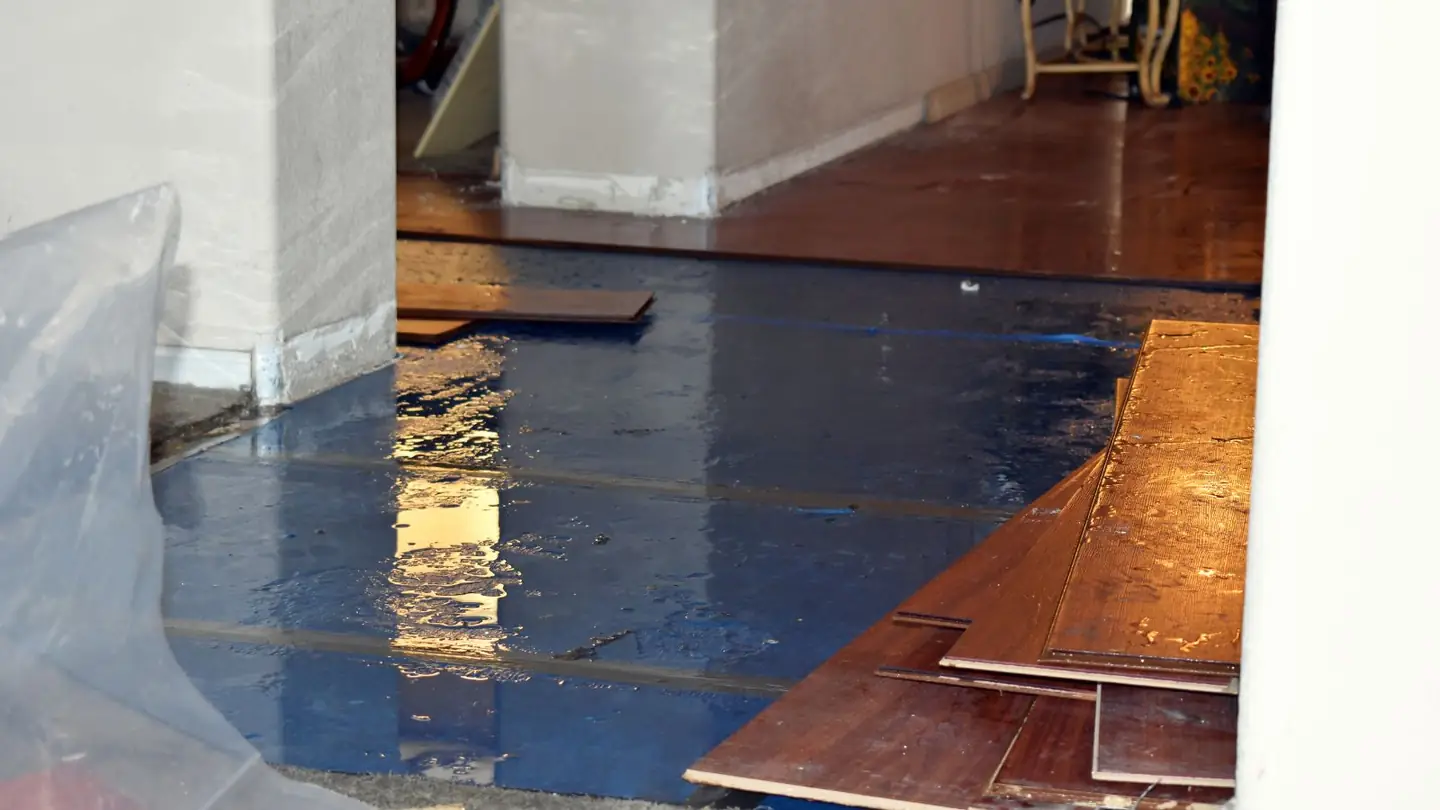
Hardwood that has taken on water can often be saved if it is dried quickly and the water was clean. It usually cannot be saved if the boards have lifted off the subfloor, the water was contaminated or the floor stayed wet long enough to darken and soften. The only way to know is to measure moisture in the boards and what sits under them.
In The Colony, TX most floor damage we hear about starts with a supply line, an appliance hose or a slab leak, not a flood. The signs below separate a floor that is drying out from one that is failing.
Reading the floor: cupping, crowning and buckling
Cupping
Cupping means the edges of each board rise higher than the center, so the floor looks like a row of shallow troughs. It happens when the bottom of a board holds more moisture than the top. Mild cupping that appears after a short leak often relaxes as the wood dries evenly, though the floor may need sanding afterward.
Crowning
Crowning is the reverse: the center of each board is higher than its edges. It sometimes shows up after a cupped floor is sanded while still wet, or after the top surface takes on more moisture than the underside. Wait for readings to settle before anyone puts a sander on the floor.
Buckling
Buckling is the serious one. Boards lift away from the subfloor, sometimes in a ridge or a tent several inches high. It means the wood has swelled so much it has pushed against walls and broken its fasteners or its bond. A floor that has buckled is rarely a candidate for drying in place, and boards in the affected zone are typically replaced.
Talk to dispatch
Describe what you see and we will tell you what happens next, in plain words, before any work starts.
What to do in the first day
- Stop the source. Close the shutoff valve to the fixture or the main valve and call a plumber if the leak is inside a wall.
- Remove standing water and blot with towels. Move rugs, furniture and anything holding moisture against the wood.
- Photograph the floor from several angles and keep one wide shot with the leak source in frame.
- Run the HVAC fan or ordinary room fans only for general air movement until a crew arrives.
- Call for moisture mapping. A meter reads the boards, and a thermal imaging camera shows wet areas that the eye cannot.
What not to do
Heat guns, hair dryers and space heaters feel like quick fixes and do the opposite. Fast surface heat dries the top of the board while the underside stays wet, and it can split the finish and the wood. Do not seal, wax or refinish a floor that has not been confirmed dry, because trapping moisture under a sealer invites mold and permanent cupping.
Do not pull up boards on your own without photographing them first, since an adjuster may need to see the damage. And avoid nailing down lifted boards. That locks the problem in place and makes later repair harder.
Can the boards be dried?
| Situation | Likely path | Why |
|---|---|---|
| Clean water, caught quickly, minor cupping | Dry in place | Specialized drying mats or panels, air movers and dehumidifiers can pull moisture out of boards and subfloor. |
| Gray water such as a dishwasher or washer overflow | Case by case | Contamination and the finish matter. A crew may recommend removal of affected boards. |
| Black water, sewage or flood runoff | Replace | Contaminated porous material is removed under ANSI/IICRC S500 practice. |
| Buckled boards, dark staining or soft wood | Replace affected area | Fibers are physically damaged and rarely return to flat. |
| Floor wet for many days before discovery | Replace or test closely | Long wetting can leave swelling and mold risk even after drying. |
Engineered flooring and laminate behave differently from solid hardwood. Their layers can delaminate, so they are less forgiving.
Subfloor moisture and how long drying takes
The boards are only half the story. If the floor sits on a wood subfloor over a crawl space or an upper story, that plywood or plank layer holds water longer than the finish. If it was installed over a concrete slab, moisture can rise from the slab or pool beneath a glued or floating installation. A crew can tell which you have with a meter and by lifting a board.
Drying time depends on the water category, how long the floor stayed wet, the thickness of the boards, the subfloor and the humidity in the house, so no honest crew will quote a fixed number. Drying continues until readings return to the dry standard for that material, and only then should anyone talk about refinishing. For the rebuild stage, see our water damage repair service.
Dry first, then repair
If the flooring can be saved, expect sanding and refinishing after readings are normal. If boards are replaced, a new run must be blended into the old, which depends on species, stain and the width of the planks. Early water mitigation is what keeps a small repair from becoming a whole-room replacement.
Local note
The Colony: why freezes matter to floors
Federal records show FEMA declared DR-4586 for the Texas severe winter storms of 2021, and Denton County was designated for individual and public assistance. That freeze is a reminder that a frozen pipe can split long before water shows on the floor, so the damage often surfaces on thaw.
National Weather Service normals for the DFW area average 29 freezes per season, with 37.01 inches of precipitation a year. So freezing is routine, not rare. If a hard freeze is forecast, insulating exposed pipes and knowing where your main shutoff is can save a floor. And if damage appears afterward, the Texas Department of Insurance says to photograph before repairs and keep damaged materials for the adjuster.
Frequently asked questions
Will cupped hardwood flatten on its own?
Sometimes. If the water was clean and the floor dries evenly, mild cupping can relax over days to weeks, and a crew can monitor it with a moisture meter. Sand or refinish only after readings show the wood and subfloor are dry.
Is it safe to put a fan on a wet hardwood floor?
General air movement is fine for a short time, but heat is not. Controlled drying with air movers and dehumidifiers under a crew's plan is safer than heaters, which can crack boards.
Can I cover the wet floor with a rug until I decide?
No. A rug traps moisture and hides the damage. Lift it, let air reach the wood and call for a moisture reading.
Does homeowners insurance cover a floor ruined by a burst pipe?
The Texas Department of Insurance says policies generally cover sudden and accidental damage like a burst pipe, while gradual seepage is usually excluded. Check your policy and report quickly. Keep photos and receipts for any temporary protection.
After a freeze like the one in 2021, how long should I watch for hidden floor damage?
Report hidden damage within days of seeing it. Cupping, a musty smell or boards that feel soft can show up weeks after a slow leak starts, so check floors near kitchens, baths and exterior walls. A moisture meter can confirm what the eye cannot.
Do you also serve homes outside The Colony?
Yes, including Plano and Lewisville, using the same moisture-mapping approach on wood floors.